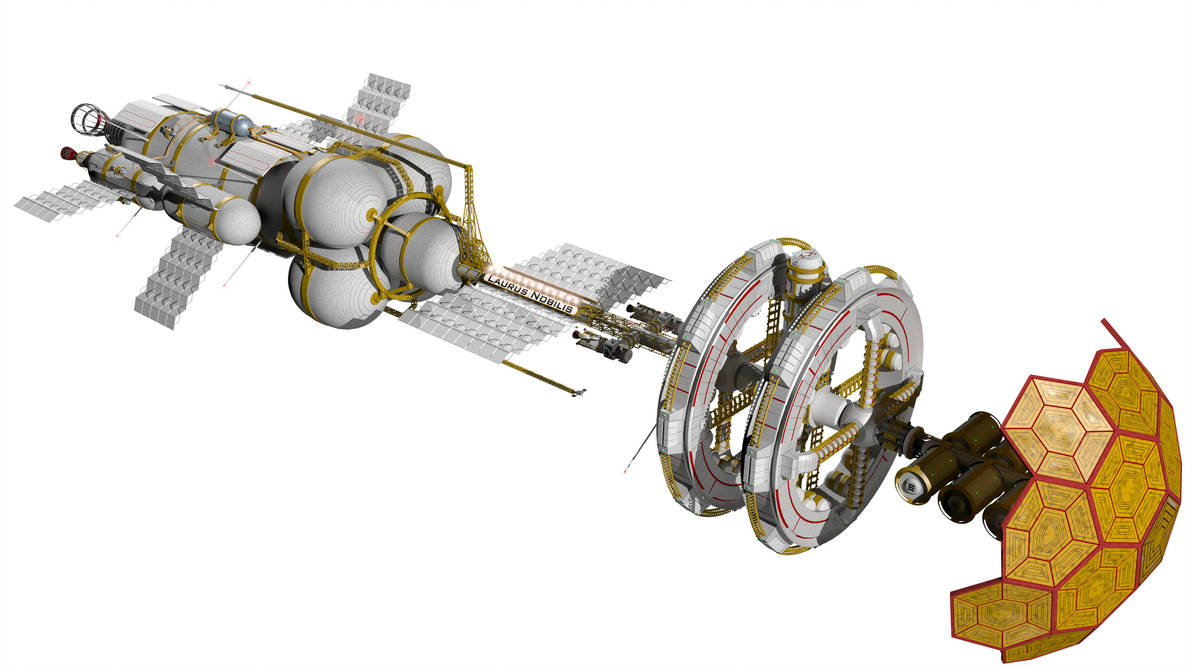
Had this idea bouncing around for a type of space adventure/horror(?) game. You are arriving late to a star system that humanity had sent several waves of colony ships milennia before you got there. This is a hard-science fiction world, so no Faster-Than-Light travel. You arrive there the old fashioned way (Generational ship that took several hundred years) and explore the star system to see what, if any, colonialization attempts took hold.
I’m thinking it would be similar to uncovering vaults in Fallout, but with a somber tone. You do not find crazy experiments on captive populations (although that is a possibility) but instead discover the aftermath of failed attempts to establish a foothold for humanity out among the stars.
To help me come up with what colonial remnants you are liable to stumble across, I decided to break down space colonization into groups:
- how far away is the destination,
- the length of the journey (in terms of how long it takes to an outside observer vs. how much time the ship experiences),
- who/what is going to be doing the colonizing,
- how many are you bringing along,
- how are you getting them to the destination,
- the design of the ship(s),
- who/what is running the ship,
- where the colony is going to exist at the destination,
- and most important of all; what the colonists are hoping to achieve.
We can answer the first question pretty definitively: 4.25 LY.
For the game, I’m envisioning this as Humanity’s first foray into space colonization. That means we’d be leaving from Earth and the destination will be Proxima Centauri, which is 4.25 Light Years away.
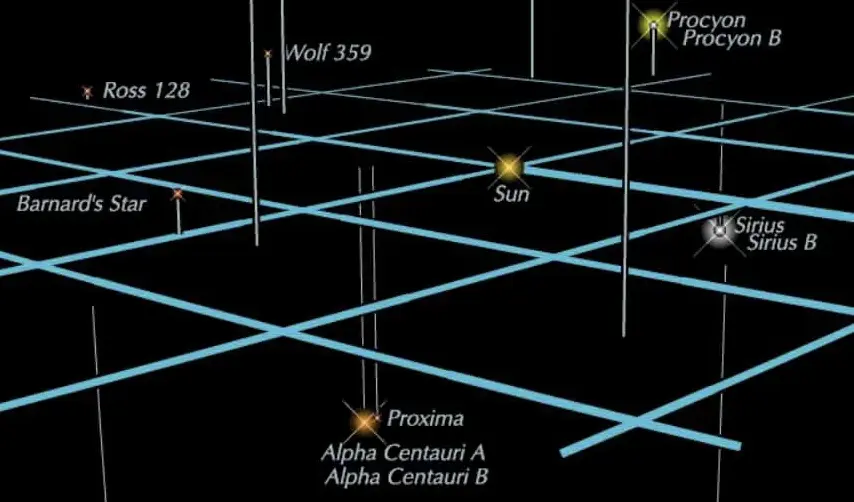
So, how long would it take to travel 4.25 LYs?
Depending on the speed we go, that can be anywhere from 5 years on the short end (near lightspeed) to over 80,000 years using current speeds we’ve attained by the Voyager probes and the like.
While the prospect of having a time range for the game be an order of magnitude larger than that of humanity’s entire recorded history is tempting, I think we may need to narrow our focus some.
Thankfully, we can assume that by the time we’ve gotten technologically advanced enough to be building colony ships and launching them off to our nearest star, we wouldn’t be sending anything out at the relative snail’s pace we are currently capable of.
So for the sake of the game, we’ll push the long end of that range over to the mere thousands of years travel time rather than several tens of thousands of years. But the hard limit on the short end will remain at 4.25 years, thanks to General Relativity.
Ship speeds
- Conventional – runs at relatively slow speed (1% C) travel time measured in centuries/millenia and little to no time dilation
- Relativistic – runs at 10%-20% C, travel time measured in decades with low dilation measuring months or days time difference between Earth and onboard
- Near Lightspeed – runs at 50%-90% C, travel time measured in years with mid time dilation (1.5x-2x amount of time on earth vs. onboard)
This leaves us with a huge range of time, which is good! For this game, we want to have the player explore the aftermath of several colonization attempts across different timescales, so having our player arrive at Proxima Centuari at a time when some colonies are just arriving there themselves and are setting up shop, others having arrived a couple milennia ago will already be either ancient ruins or thriving empires, and everything in between!
Colonists
So who, or what, is actually going to be traveling to this distant star system and setting up a colony?
One would assume humans, but that need not be the case. Humans can be a fragile bunch and very difficult to transport across the cosmos intact. You might want, or need, to send a genetically or technologically modified group of colonists to better ensure they survive the trip.
And what if the goal is to settle a planet or moon with a subsurface ocean like Europa has? Why send humans when you can send genetically modified, super intelligent whales instead? Perhaps it’s some other extreme in tempurature, or pressure, or gravity. Somewhere that a normal human would die instantly, but a modified/engineered lifeform would thrive?
Or perhaps this trip you aren’t sending the actual colonists yet, but a construction crew. It arrives first to build and staff the colony, then you send the colonists. You might not want to send anything organic at all, in that case.
What kind of colonist you are bringing will directly affect many of the other questions about the number to bring, method of transport, pretty much every other question on the list. For example: if you are bringing regular humans, you’ll want a lot of them (we’re talking several thousand individuals) whereas if you are bringing just A.I., you could only need one.
Here are a few variations on who might be going to this new home:
- Natural Humans – regular humans that live normal human lifespans (80-100 years)
- Rejuvinated – some method of consciousness transfer to clones, embryos, or other human bodies
- Augmented – altered humans with extended/indefinite lifespans
- Evolved – lifeform altered past point of being considered human, but still intelligent life.
- Robotic – no physical human component involved (either uploaded human consciousness or A.I.)
Colony Travel Methods
So, now that you have yourself the colonists, you need to get them there. The best way to do it will depend on what you are transporting, as there’s no point in having to maintain a pressurized hull with breathable atmosphere and artificial gravity if all your colonists are stored as data on hard drives.
But a big factor, other than what you’re transporting, is how long it’s going to take. If you’re taking regular humans, the method of ‘shipping’ will vary greatly if your trip is only a decade or two vs. hundreds, or possibly thousands, of years.
However, if all your colonists are just software, you’d just store them on hard drives awaiting uploading into fresh bodies on arrival no matter how long it’ll take to travel.
Here are the methods I’ve devised:
- Conventional/Generational – colonists live aboard ship in real time during entire journey.
- Cryogenic – colonists in suspended animation for all or part of journey
- Genetic Library – colonists stored as genetic material, no physical bodies present during trip
- Robotic – no organic component involved (either uploaded human consciousness or A.I. stored as code, or running in V.R.)
- Transmission – colonists are not actually aboard ship, but will be transmitted to the colony as data later once the colony is established
Ship Designs
Another big variable that will heavily depend on who/what you’re transporting and for how long is the design of your ship(s). Transporting regular humans for centuries while they live there? Better have artificial gravity, breathable atmosphere, entertainment, living spaces, food growth, the works! It’ll be a monstrously large space-city.
Shipping an augmented population on ice for only a decade? Perhaps you can get away with no living spaces at all, just cryo-pods in cargo bays while bug-like robots skitter along the ship in near vacuum making repairs.
- Mothership/Ark – ship is colossal, maintains an earthlike environment on board with artificial gravity
- Seeder ship – ship is compact, no artificial gravity or living environment, carries genetic libraries or frozen embryos ready to populate a planet
- Data Center – similar to a seeder, but only carrying storage medium for non-organic life forms
- Probe – ship only carries equipment to establish a data transmission receiver once it arrives in order to get their colonists sent to them digitally from Earth
- Flotilla – fleet of ships separating out functions by ship (fuel storage, colonists, living areas, cargo, supplies, power gen, defense, etc.) artificial gravity and living environments vary by ship function.
Ship Maintenance Methods
So you have yourself a ride, now it’s time do decide who, or what, is behind the wheel.
If your colonists are essentially cargo, then you’ll need a separate crew to run things. But, if you’re on an Ark ship with generations of colonists living and dying on the way, they can be your crew as well.
But you might not want that! Depending on the ‘goal’ of the mission, having the colonists run the ship might cause problems if your goal is to establish some sort of vassal state. Given a few generations, the colonists might decide to forgo whatever the original patrons of this ship wanted them to do. Perhaps this is a communist venture that intended to prove to the cosmos that communism is the way of the future and the ideal, only to have the actual colonists discover along the trip that it doesn’t really work all that well.
Basically, the colonists on board the ship are not necessarily going to be the ship’s crew as well, so we can make the crew a separate variable for the game. Are they just janitorial staff? Nannies? Prison wardens (figuratively or literally)? You decide.
- Rotating crew – regular humans run ship throughout regular human lifespans.
- Rejuvinated or Augmented crew – ship run by same group of humans throughout journey. done thru either lifespan augmentation, periodic rotating suspended animation, or cloning to preserve original crew.
- Automatic – ship run by automated systems (Either A.I., uploaded human consciousness(es), or regular computer systems)
Colony Locations
Okay, you’ve made it there, but where exactly is ‘there’?
If you are a space ship arriving at ‘Sol’, you aren’t trying to land on the star itself (hopefully). There are thousands of places to land in our solar system alone: 8 planets, several dwarf planets, hundreds of moons, and countless asteroids.
Sadly, our knowledge of what Proxima and Alpha Centauri AB have orbiting them is very scant. As of now, only two planets are confirmed to orbit Proxima with a possible unconfirmed third. And the binary stars of Alpha Centauri (A and B) are theorized to be unable to keep planets orbiting them due to the nature they orbit each other.
This scarceness of information for our game is both good and bad. Good in that, what with such a gap of knowledge of what’s there, we can speculate a solar system structure as much as we want! Dozens of Earth-like planets orbiting around A-B, or massive asteroid fields littering the span between proxima b & c, or brown dwarfs peppering the space between Proxima and Alpha AB.
But I keep thinking of sci-fi stories way back in the 50’s and 60’s of earth-like conditions on Mars, or even funnier, Venus. Or a little further back into the early 1900’s and you get the same thing but on the moon! I’d hate to come up with a dozen planets and moons and asteroid fields today only to have astronomy disprove the possibility of it all the next day.
But I think it’s safe to say that if we keep our speculation modest, we can still accommodate most if not all of the possibilities listed below.
- Planet surface – colony can be either underground, underwater, on land, or suspended in atmosphere inside the influence of the planet’s gravity well.
- Asteroid – colony is an asteroid either hollowed out and used as a protective shell or built upon the surface
- Planetary orbit – colony is in close orbit with a planet, moon, or asteroid. The interior is not under the gravitational influence of the planetary body directly (inhabitants only experience micro-gravity)
- Stellar orbit – colony is orbiting the system’s star(s) and not subject to any other planetary body’s gravity well
- Comet-like orbit – colony that has an extreme elliptical orbit, taking it to the extremes of the system’s area
- Wandering orbit – colony takes artificially-controlled paths throughout the system, varying their speed and location (can be proactively done for resources or trade, or done as a necessity to avoid solar flares or other hazards)
Colonization Goals
Last, but probably most importantly: What are you trying to achieve here?
Really, this one sounds like it should be first on the list. So much of the other questions are much easier to answer once you pick this one. After all, if your goal is to recreate a part of human history (say the Middle Ages or Ancient China), then sending a ship full of cyborgs and augmented immortals seems like a bad idea.
But with a lot of game systems and styles I’ve played with, I find that when you are putting together a list of variables to help you construct a world, some of the best roleplaying and storytelling spawns from these types of mismatches.
Going to create a perfect utopian community for humans, but you sent hyper-intelligent space-dolphins instead? I’m sure someone out there tried to make it work out under those conditions…
- Terraform – remake a planet or asteroid to have survivable conditions
- Recreate – replicate earth as much as possible (simple as comparable air/water/gravity conditions or complex as rearranging continents to mimic Earth’s surface)
- Sister City – Duplicate a culture/society/state to preserve/promote way of life
- Utopia – create settlement that solves the problems plaguing human society
- Coexist – adapt human life to survive/thrive at new destination
- Uplift – provide an existing lifeform at the new location with tech or genetic engineering to be on par with humanity
- Turn back the Clock – revert to a ‘simpler time’ for humanity or earth (middle ages, Eden, Jurassic epoch, etc.)
- Play God – establish own little world where the fantasies of one or a few are indulged
With all this in mind, my next series of posts will be the combinations of these variables to see what sort of scenarios we can cook up for our players to discover.
One extremely major issue I just realized with this whole setup is the fact that radio transmissions travel at light speed along with, ya know, light. Yes, there is time lag involved, but at most that’ll be 4.25 years out of date when talking about our nearest stellar neighbors. Sure, a lot can happen in 4-5 years, but civilizations won’t rise and fall without a trace in that timespan.
And that’s direct communication. Even if a colony establishes itself in another system and doesn’t bother to even try to communicate back to Earth, they’d still be visible from Earth with telescopes. Same thing with approaching ships like the one the player would be arriving on in our game. What’s going on in the system won’t be much of a mystery to solve.
Or will it?
How much can you really tell about a civilization in another solar system just from a telescope? We can detect planets pretty well right now, along with some basics about their temp, chemical composition, atmosphere, etc. But we can’t see continents, or cities, or orbiting space stations and the like.
But that’s now. What will we be able to see in a couple thousand more years of technological advancement? will we be able to watch what’s going on on a planet in another solar system with the detail we currently get from a low-orbit satellite?